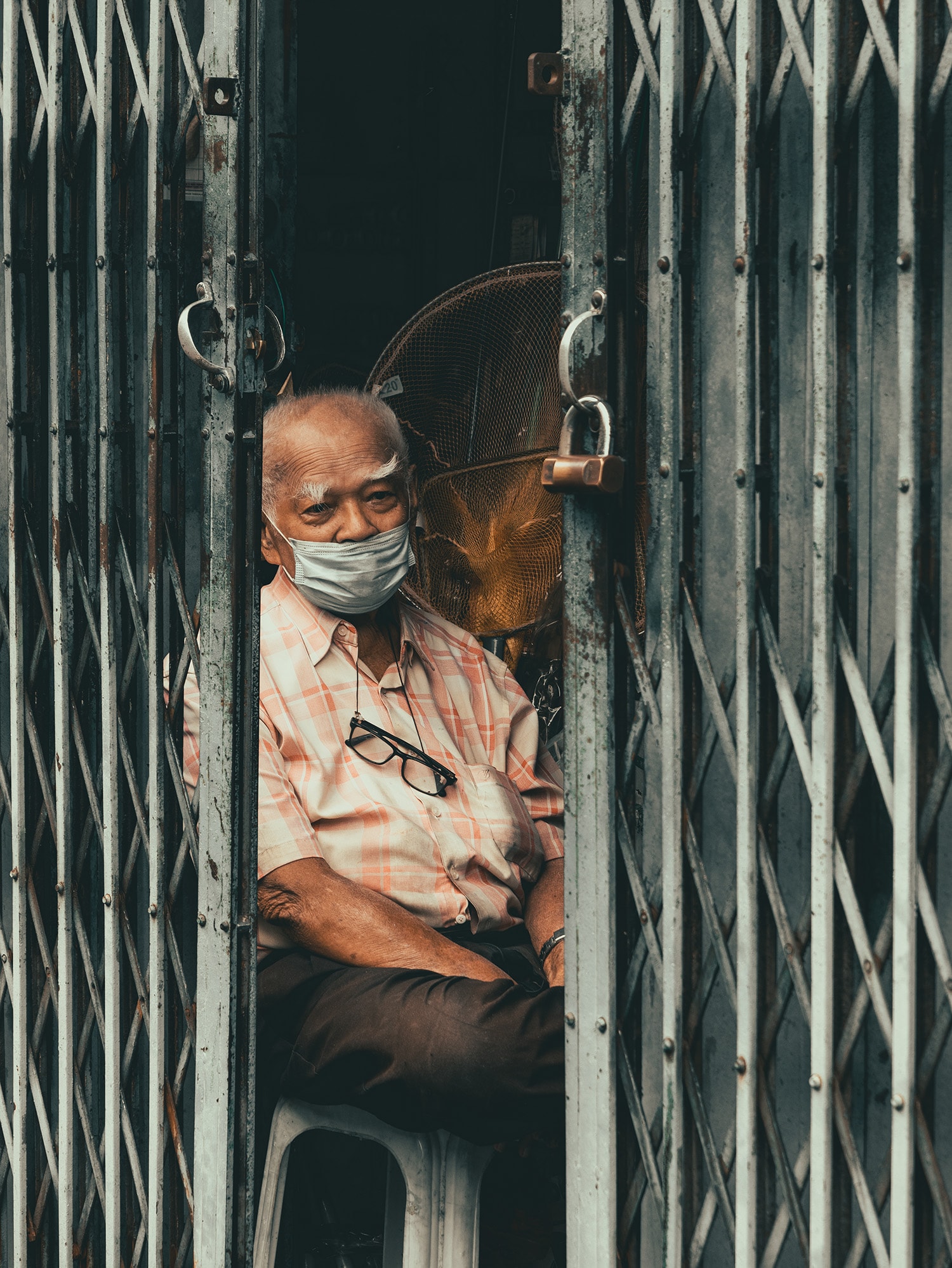
Seated quietly behind the criss-crossed bars of a traditional folding security gate, an elderly man gazes out with calm, weathered eyes, partially obscured by a face mask and framed almost sculpturally by the surrounding metalwork. The soft warm light catches the plaid of his shirt and the silver of his hair, giving the portrait a gentle intimacy despite the industrial, cage-like structure separating him from the camera. This style of retractable metal gate is a common feature across older shophouses in Malaysia, often used to secure storefronts and homes overnight while still allowing airflow and a partial view to the street. A pair of glasses hangs loosely around his neck, and a woven basket or net peeks out from the shadows behind him, small domestic details that hint at a life lived simply, largely unbothered by the camera's presence. There's a compelling tension in this photograph — between confinement and openness, privacy and visibility — created almost entirely by the geometric patterns of the gate itself. It's a quiet character study, framed not by choice, but by the everyday architecture of urban Malaysian life.